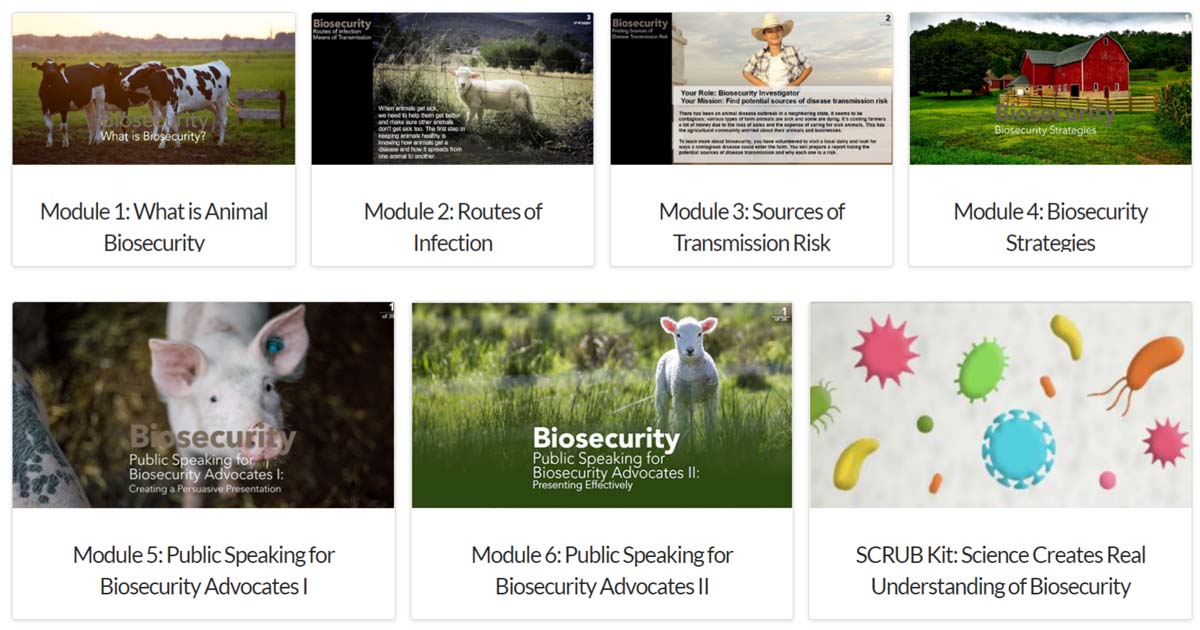
USDA grant<\/a> that supported this biosecurity initiative. She stated that, “students in agriculture need access to high quality online educational opportunities now more than ever. Our biosecurity modules offer the flexibility of teacher-guided instruction, or students can learn at their own pace and convenience.”<\/p>\nThis work was supported by the USDA National Institute of Food and Agriculture (NIFA), under award number 2015-69004-23273.<\/p>\n","protected":false},"excerpt":{"rendered":"
Livestock and poultry are susceptible to infectious diseases and many of these diseases are zoonotic, meaning they can be transmitted to people. A few more well-known zoonotic diseases include ringworm, rabies and soremouth. The most effective strategy for protecting farm animal health is to prevent or reduce the chances of introducing a disease into a … <\/p>\n
Continue reading “Youth Biosecurity Learning Modules Recently Updated”<\/span><\/a><\/p>\n","protected":false},"author":7974,"featured_media":0,"comment_status":"closed","ping_status":"closed","sticky":false,"template":"","format":"standard","meta":{"advanced_seo_description":"","jetpack_seo_html_title":"","jetpack_seo_noindex":false,"jetpack_seo_schema_type":"","_jetpack_newsletter_access":"","_jetpack_dont_email_post_to_subs":false,"_jetpack_newsletter_tier_id":0,"_jetpack_memberships_contains_paywalled_content":false,"_jetpack_feature_clip_id":0,"_jetpack_memberships_contains_paid_content":false,"footnotes":"","jetpack_post_was_ever_published":false},"categories":[12,28,57],"tags":[31,16,39,50,83],"class_list":["post-1621","post","type-post","status-publish","format-standard","hentry","category-cals","category-faculty","category-grants","tag-4-h","tag-asci","tag-farm-safety","tag-food-safety","tag-students"],"jetpack-related-posts":[{"id":2217,"url":"https:\/\/site.uvm.edu\/cals-news\/4-h-bonanza-student-passion-bovine\/","url_meta":{"origin":1621,"position":0},"title":"4-H Bonanza Showcases Student Passion for All Things Bovine","author":"CALS Communications","date":"November 9, 2022","format":false,"excerpt":"Seventy-two 4-H members from across Vermont participated in the 4-H Bovine Bonanza, held at the University of Vermont's Paul R. Miller Research & Education Center on November 5, 2022. The instructors for the event were the Cooperative for Real Education in Agriculture Management (CREAM) students. With the farm hosting the\u2026","rel":"","context":"In "CALS"","block_context":{"text":"CALS","link":"https:\/\/site.uvm.edu\/cals-news\/category\/cals\/"},"img":{"alt_text":"A big group of 4-H students are talking with an instructor in a dairy milking parlor.","src":"https:\/\/i0.wp.com\/site.uvm.edu\/cals-news\/files\/2022\/11\/4-h-bovine-bonanza-dairy-barn.jpg?resize=350%2C200","width":350,"height":200,"srcset":"https:\/\/i0.wp.com\/site.uvm.edu\/cals-news\/files\/2022\/11\/4-h-bovine-bonanza-dairy-barn.jpg?resize=350%2C200 1x, https:\/\/i0.wp.com\/site.uvm.edu\/cals-news\/files\/2022\/11\/4-h-bovine-bonanza-dairy-barn.jpg?resize=525%2C300 1.5x, https:\/\/i0.wp.com\/site.uvm.edu\/cals-news\/files\/2022\/11\/4-h-bovine-bonanza-dairy-barn.jpg?resize=700%2C400 2x, https:\/\/i0.wp.com\/site.uvm.edu\/cals-news\/files\/2022\/11\/4-h-bovine-bonanza-dairy-barn.jpg?resize=1050%2C600 3x"},"classes":[]},{"id":2434,"url":"https:\/\/site.uvm.edu\/cals-news\/vermont-dairy-mapping-project-new-england-milk-supply\/","url_meta":{"origin":1621,"position":1},"title":"Vermont Dairy Mapping Project Aims to Help Secure the New England Milk Supply","author":"CALS Communications","date":"January 25, 2023","format":false,"excerpt":"New England's dairy milk supply is a vast network of production, processing and delivery of raw milk and products that crosses several state borders. Vermont is New England's dairy powerhouse, producing 2.5 billion pounds of milk for the regional milkshed in 2022, from farms large and small, conventional, and certified\u2026","rel":"","context":"In "CALS"","block_context":{"text":"CALS","link":"https:\/\/site.uvm.edu\/cals-news\/category\/cals\/"},"img":{"alt_text":"An aerial map of dairy farm buildings outlined in different colors to identify animal protection zones.","src":"https:\/\/i0.wp.com\/site.uvm.edu\/cals-news\/files\/2023\/01\/secure-farm-map.jpg?resize=350%2C200","width":350,"height":200,"srcset":"https:\/\/i0.wp.com\/site.uvm.edu\/cals-news\/files\/2023\/01\/secure-farm-map.jpg?resize=350%2C200 1x, https:\/\/i0.wp.com\/site.uvm.edu\/cals-news\/files\/2023\/01\/secure-farm-map.jpg?resize=525%2C300 1.5x, https:\/\/i0.wp.com\/site.uvm.edu\/cals-news\/files\/2023\/01\/secure-farm-map.jpg?resize=700%2C400 2x, https:\/\/i0.wp.com\/site.uvm.edu\/cals-news\/files\/2023\/01\/secure-farm-map.jpg?resize=1050%2C600 3x"},"classes":[]},{"id":1226,"url":"https:\/\/site.uvm.edu\/cals-news\/zia-biosecurity-risk-research\/","url_meta":{"origin":1621,"position":2},"title":"Asim Zia Leads Livestock Disease Risk Management Research","author":"CALS Communications","date":"March 25, 2022","format":false,"excerpt":"Community Development and Applied Economics Professor Asim Zia, in collaboration with researchers from the departments of Animal and Veterinary Sciences and Computer Science, has received a $2.5 million grant from USDA NIFA for livestock disease risk management research. The transdisciplinary project is entitled, Predicting Livestock Disease Transmission Dynamic Under Alternate\u2026","rel":"","context":"In "CALS"","block_context":{"text":"CALS","link":"https:\/\/site.uvm.edu\/cals-news\/category\/cals\/"},"img":{"alt_text":"Four piglets in a barn.","src":"https:\/\/i0.wp.com\/site.uvm.edu\/cals-news\/files\/2022\/03\/piglets.jpg?resize=350%2C200","width":350,"height":200,"srcset":"https:\/\/i0.wp.com\/site.uvm.edu\/cals-news\/files\/2022\/03\/piglets.jpg?resize=350%2C200 1x, https:\/\/i0.wp.com\/site.uvm.edu\/cals-news\/files\/2022\/03\/piglets.jpg?resize=525%2C300 1.5x, https:\/\/i0.wp.com\/site.uvm.edu\/cals-news\/files\/2022\/03\/piglets.jpg?resize=700%2C400 2x, https:\/\/i0.wp.com\/site.uvm.edu\/cals-news\/files\/2022\/03\/piglets.jpg?resize=1050%2C600 3x"},"classes":[]},{"id":2649,"url":"https:\/\/site.uvm.edu\/cals-news\/science-creates-real-understanding-of-biosecurity-curriculum-published\/","url_meta":{"origin":1621,"position":3},"title":"Science Creates Real Understanding of Biosecurity (SCRUB) Agriculture Curriculum Published","author":"CALS Communications","date":"March 15, 2023","format":false,"excerpt":"A series of farm biosecurity learning modules were developed during a five-year livestock biosecurity grant project directed by UVM Animal and Veterinary Sciences Research Associate Professor Julie Smith. Also part of the grant project and recently published, the SCRUB (Science Creates Real Understanding of Biosecurity) curriculum contains modules and activities\u2026","rel":"","context":"In "CALS"","block_context":{"text":"CALS","link":"https:\/\/site.uvm.edu\/cals-news\/category\/cals\/"},"img":{"alt_text":"A graphic of different types of viruses, bacteria and other disease organisms.","src":"https:\/\/i0.wp.com\/site.uvm.edu\/cals-news\/files\/2023\/03\/scrub-biosecurity.jpg?resize=350%2C200","width":350,"height":200,"srcset":"https:\/\/i0.wp.com\/site.uvm.edu\/cals-news\/files\/2023\/03\/scrub-biosecurity.jpg?resize=350%2C200 1x, https:\/\/i0.wp.com\/site.uvm.edu\/cals-news\/files\/2023\/03\/scrub-biosecurity.jpg?resize=525%2C300 1.5x, https:\/\/i0.wp.com\/site.uvm.edu\/cals-news\/files\/2023\/03\/scrub-biosecurity.jpg?resize=700%2C400 2x, https:\/\/i0.wp.com\/site.uvm.edu\/cals-news\/files\/2023\/03\/scrub-biosecurity.jpg?resize=1050%2C600 3x"},"classes":[]},{"id":1397,"url":"https:\/\/site.uvm.edu\/cals-news\/livestock-disease-tactical-sciences\/","url_meta":{"origin":1621,"position":4},"title":"Livestock Disease Preparedness a Goal for Tactical Sciences Grant","author":"CALS Communications","date":"May 25, 2022","format":false,"excerpt":"Animal and Veterinary Sciences Research Associate Professor Julie Smith, and Plant and Soil Science Research Assistant Professor Scott Merrill have been awarded $1 million dollars for a three-year research and outreach project funded through the USDA NIFA Tactical Sciences for Agricultural Biosecurity program. Entitled, \"A systems approach to securing the\u2026","rel":"","context":"In "CALS"","block_context":{"text":"CALS","link":"https:\/\/site.uvm.edu\/cals-news\/category\/cals\/"},"img":{"alt_text":"Many Holstein cows in a barn eating hay.","src":"https:\/\/i0.wp.com\/site.uvm.edu\/cals-news\/files\/2022\/05\/cows-in-barn.jpg?resize=350%2C200","width":350,"height":200,"srcset":"https:\/\/i0.wp.com\/site.uvm.edu\/cals-news\/files\/2022\/05\/cows-in-barn.jpg?resize=350%2C200 1x, https:\/\/i0.wp.com\/site.uvm.edu\/cals-news\/files\/2022\/05\/cows-in-barn.jpg?resize=525%2C300 1.5x, https:\/\/i0.wp.com\/site.uvm.edu\/cals-news\/files\/2022\/05\/cows-in-barn.jpg?resize=700%2C400 2x, https:\/\/i0.wp.com\/site.uvm.edu\/cals-news\/files\/2022\/05\/cows-in-barn.jpg?resize=1050%2C600 3x"},"classes":[]},{"id":3119,"url":"https:\/\/site.uvm.edu\/cals-news\/levee-effect-false-sense-of-security-livestock-diseases\/","url_meta":{"origin":1621,"position":5},"title":"Will the “Levee Effect” Give a False Sense of Security for Livestock Diseases?","author":"CALS Communications","date":"September 26, 2023","format":false,"excerpt":"Animal and Veterinary Sciences Research Professor Julie Smith published an article in Progressive Dairy entitled, \"Animal agriculture awaits normal accidents when it comes to biosecurity.\" She examines the effects of a move by the United Kingdom and the European Union for animal agriculture to become disease-free without vaccination. The article\u2026","rel":"","context":"In "CALS"","block_context":{"text":"CALS","link":"https:\/\/site.uvm.edu\/cals-news\/category\/cals\/"},"img":{"alt_text":"Several adult sheep with lambs standing in a field.","src":"https:\/\/i0.wp.com\/site.uvm.edu\/cals-news\/files\/2023\/06\/sheep.jpg?resize=350%2C200","width":350,"height":200,"srcset":"https:\/\/i0.wp.com\/site.uvm.edu\/cals-news\/files\/2023\/06\/sheep.jpg?resize=350%2C200 1x, https:\/\/i0.wp.com\/site.uvm.edu\/cals-news\/files\/2023\/06\/sheep.jpg?resize=525%2C300 1.5x, https:\/\/i0.wp.com\/site.uvm.edu\/cals-news\/files\/2023\/06\/sheep.jpg?resize=700%2C400 2x, https:\/\/i0.wp.com\/site.uvm.edu\/cals-news\/files\/2023\/06\/sheep.jpg?resize=1050%2C600 3x"},"classes":[]}],"jetpack_likes_enabled":true,"jetpack_sharing_enabled":true,"jetpack_featured_media_url":"","_links":{"self":[{"href":"https:\/\/site.uvm.edu\/cals-news\/wp-json\/wp\/v2\/posts\/1621","targetHints":{"allow":["GET"]}}],"collection":[{"href":"https:\/\/site.uvm.edu\/cals-news\/wp-json\/wp\/v2\/posts"}],"about":[{"href":"https:\/\/site.uvm.edu\/cals-news\/wp-json\/wp\/v2\/types\/post"}],"author":[{"embeddable":true,"href":"https:\/\/site.uvm.edu\/cals-news\/wp-json\/wp\/v2\/users\/7974"}],"replies":[{"embeddable":true,"href":"https:\/\/site.uvm.edu\/cals-news\/wp-json\/wp\/v2\/comments?post=1621"}],"version-history":[{"count":10,"href":"https:\/\/site.uvm.edu\/cals-news\/wp-json\/wp\/v2\/posts\/1621\/revisions"}],"predecessor-version":[{"id":1624,"href":"https:\/\/site.uvm.edu\/cals-news\/wp-json\/wp\/v2\/posts\/1621\/revisions\/1624"}],"wp:attachment":[{"href":"https:\/\/site.uvm.edu\/cals-news\/wp-json\/wp\/v2\/media?parent=1621"}],"wp:term":[{"taxonomy":"category","embeddable":true,"href":"https:\/\/site.uvm.edu\/cals-news\/wp-json\/wp\/v2\/categories?post=1621"},{"taxonomy":"post_tag","embeddable":true,"href":"https:\/\/site.uvm.edu\/cals-news\/wp-json\/wp\/v2\/tags?post=1621"}],"curies":[{"name":"wp","href":"https:\/\/api.w.org\/{rel}","templated":true}]}}
 <\/p>\n