
School-Based Health Care
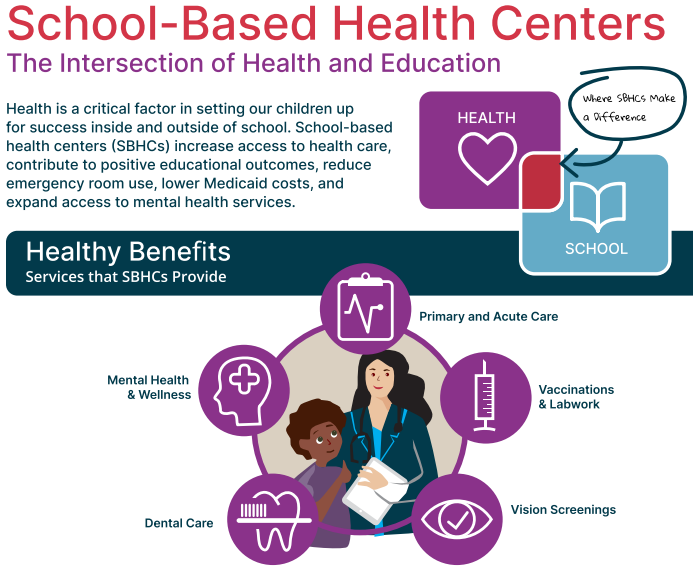
School-based health centers (SBHCs) are clinics located in or near schools that provide healthcare services to elementary, middle, and high school students. These services go beyond what is normally found in a school nurse’s office. Licensed providers such as physicians, nurse practitioners, mental health counselors, and dental providers typically staff SBHCs. Students are seen for a variety of issues, including acute care, chronic care, preventive care, well-child exams, and mental health care.
Infographic from School-Based Health Alliance.

Community Schools & Reducing Chronic Absenteeism
Every Day Counts is an initiative to reduce absenteeism in Vermont schools and studies how strong partnerships between schools, health services, and families can boost attendance. In collaboration with Vermont Community Schools, affiliated faculty from the UVM Larner College of Medicine are investigating interventions and practices to help reduce absenteeism in Vermont schools.
Rural Mental Health Partnerships
The Catamount Counseling Collaborative for Rural Schools (CCCRS), run by an interdisciplinary team from the University of Vermont College of Education & Social Services, aims to train and place over 50 new school counselors, social workers, and clinical mental health counselors in rural Vermont Community Schools over the next several years.
School-Based Asthma Therapy Program
School-based asthma therapy (SBAT) is a relatively new approach to providing daily medications to children with asthma who require them. Instead of receiving morning doses of daily controller medications at home, children receive them on school days from the school nurse in the school nursing suite. This is in addition to reliever medications like albuterol that school nurses might administer for cough or wheezing on an as-needed basis. Studies of children who receive SBAT in urban schools have shown improved asthma outcomes. This project seeks to explore it in a rural setting, in partnership with rural Vermont Community Schools.

Weight Inclusive Nutrition & Health Education
In Vermont, individuals with eating disorders experience significant barriers to accessing care due to the lack of eating disorder treatment options available. In 2023, to address the lack of treatment options, the Vermont Legislature passed Act 56, which required the VT Department of Mental Health to write a model protocol ensuring that all school staff receive training on eating disorders. The goal of this CCSC-supported project is to assess how Vermont Community Schools are implementing the Act 56 model protocol.