
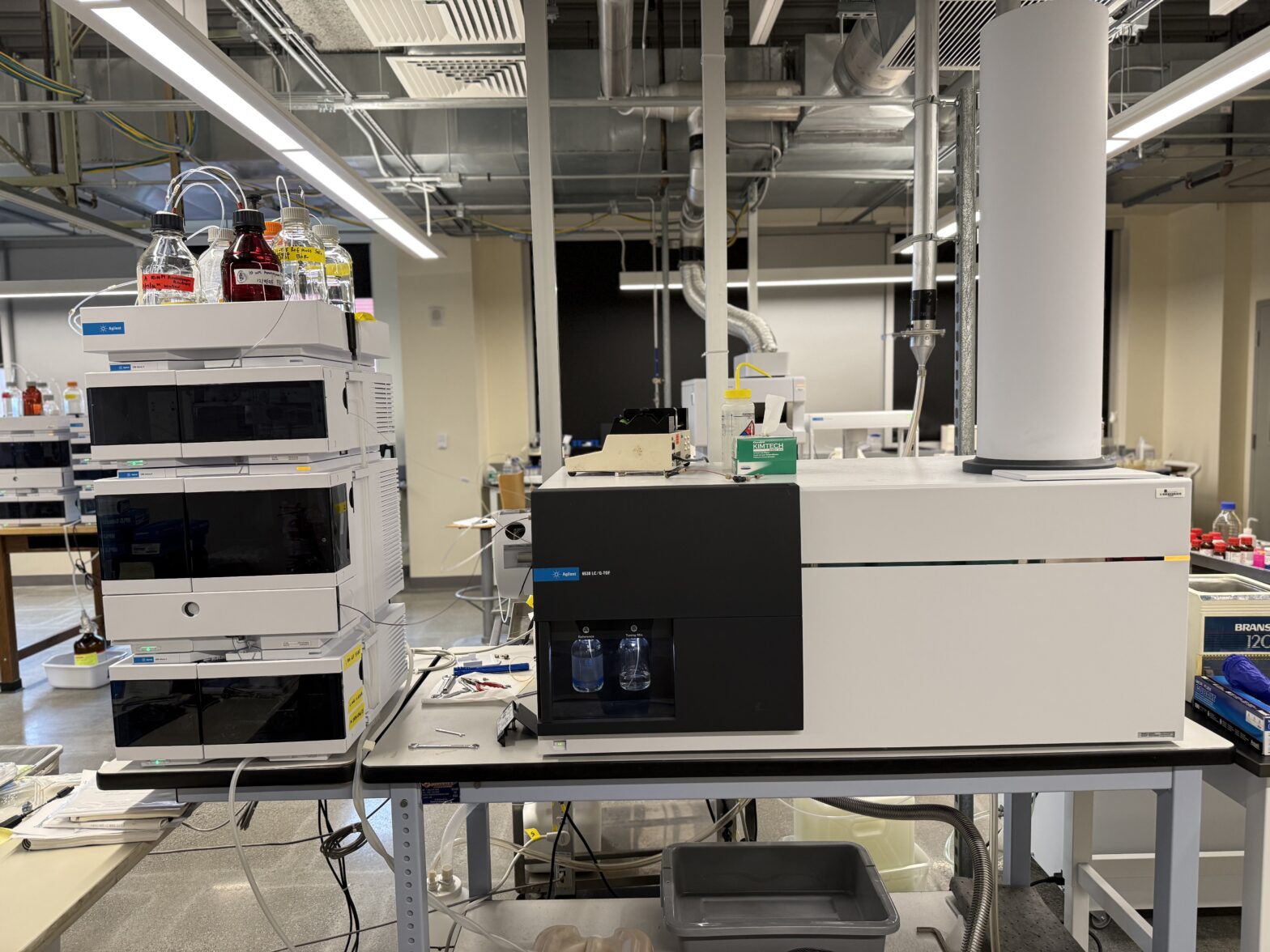
The Agilent 6530 Q-TOF LC/MS System coupled with an Agilent 1290 Infinity II UHPLC provides high-resolution, accurate-mass measurements for qualitative and quantitative analysis of complex samples. The system combines fast chromatographic separation with time-of-flight mass analysis, enabling both targeted and untargeted workflows.
The instrument supports high-resolution MS and MS/MS acquisition with excellent mass accuracy, making it well-suited for compound identification, structural elucidation, and trace-level detection across chemical, biological, and environmental applications.
Modes of Operations
Full Scan MS (High-Resolution)
- Accurate mass measurements across a wide m/z range
- Enables elemental composition determination
MS/MS (Targeted Fragmentation)
- Collision-induced dissociation (CID)
- Structural elucidation via fragmentation patterns
Auto MS/MS (Data-Dependent Acquisition)
- Automatic selection of precursor ions
- Ideal for unknown identifcation
Targeted MS/MS
- Predefined precursor selection
- High sensitivity for known compounds
All Ion Fragmentation (Data-Independent Acquisition)
- Simultaneous fragmentation without precursor selection
- Useful for screening workflows
Ionization Modes
Electrospray Ionization (ESI)
- Operates in both positive and negative modes
- Soft ionization technique producing primarily [M+H]⁺ / [M−H]⁻ ions
- Na⁺, NH₄⁺, and solvent adducts may be observed
- Best suited for:
- Polar to moderatley nonpolar compounds
- Thermally labile species
- Biomolecules and small molecules in solution
Atmospheric Pressure Chemical Ionization (APCI)
- Gas-phase ionization via corona discharge
- Typically produces protonated or deprotonated molecules with less adduct formation
- Better suited for:
- Less polar compounds
- More volatile and thermally stable analytes
Key Specification
- MS Acquisition Rate: 50 spectra/second
- MS Mass Accuracy (+): < 2ppm Root Mean Square (RMS)
- MS Sensitivity: S/N > 200:1 Measured with 1 pg reserpine on column
- MS/MS Acquisition Rate: 50 spectra/second
- MS/MS Mass Accuracy (+): <3ppm RMS
- TOF Mass range: 50-20,000 m/z
- TOF Resolution:
- > 10,000 at m/z 188
- > 20,000 at m/z 1522
- Software Platforms: MassHunter
- Data Analysis: MassHunter Quantitive Analysis, MassHunter Qualitative Analysis, MassHunter BioConfirm
Sample Requirements
Solvent & Buffer Compatibility
- Samples should be fully dissolved in LC-compatible solvents
- Aqueous/organic mixtures (e.g. water, methanol, acetonitrile)
- Preferred LC-MS grade solvents
- Preferred additives (volatile)
- Formic acid
- Acetic acid
- Ammonium formate or ammonium acetate
- Avoid (These can cause ion suppression, contamination and signal instability)
- Non-volalatile salts (e.g. NaCl, phosphate buffers)
- Detergents (e.g. SDS, Triton X-100)
- High Concentrations of DMSO, (>1-2%)
Sample Cleanliness
- Filter samples using 0.2 µm or 0.45 µm filters or alternatively centrifuge to remover particles
- Particles can
- Clog the LC system
- Damage the column
- Affect reproducibility
Concentration Guidelines
- Typical working range:
- Low nM to low µM for most analyses
- For unknowns:
- Start ~1-10 µM and dilute as needed
- Overly concentrated samples may:
- Cause detector saturation
- Increase ion suppression
- Lead to poor quantitation
Sample Submission Form
A PDF version of the sample submission form is available for reference or offline use. Additionally, a from is available through iLabs as well.
Rates
| Service (per hour) | UVM Users | External Users |
|---|---|---|
| User Instrument Time | $30.52* | – |
| Staff Assisted Use | $99.79 | $149.69 |
| Training Session | $99.79 | – |
| Prices as of July 1, 2026 | * Only Chemistry Department Personnel can be trained |