
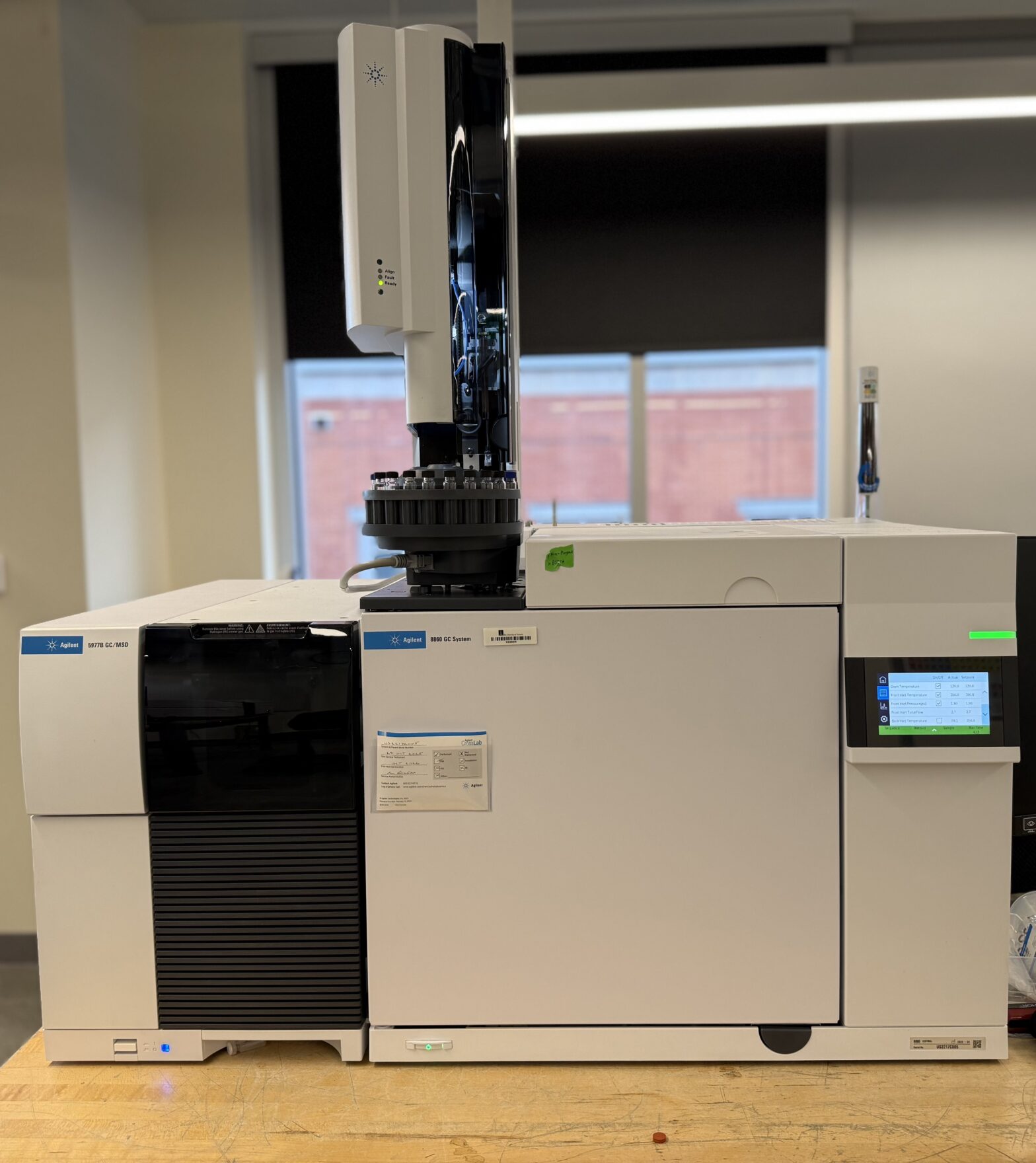
The Agilent 5977B GC/MSD System coupled with an Agilent 8860 Gas Chromatograph provides robust analysis of volatile and semi-volatile organic compounds. Gas chromatography enables high-resolution separation, while electron ionization (EI) produces reproducible fragmentation patterns for compound identification.
The system is well-suited for both targeted and unknown analysis, with extensive spectral library matching capabilities for confident compound identification.
Modes of Operations
Full Scan MS (High-Resolution)
- Accurate mass measurements across a wide m/z range of 0.6 – 1091
- Used for:
- Unknown identification
- Library matching
Ionization Modes
Electron Ionization (EI)
- Hard ionization at 70eV
- Produces reproducible fragmentation patterns
- Key advantages
- Extensive spectral libraries (e.g. NIST)
- Highly reliable compound identification
Current Instrument Setup
System Configuration
- Gas Chromatograph: Agilent 8860 Gas Chromatograph
- Mass Spectrometer: Agilent 5977B MSD
- Autosampler: 16-position for automated sample injection
- Software Platforms: MassHunter
- Data Analysis: MassHunter Qualitative Analysis
Column Configuration
- HP-5MS column (30 m x 0.25 mm x 0.25µm)
- Stationary Phase:
- (5%-phenyl)-methylpolysiloxane
- Low polarity column
- What this means practically
- Broad applicability across a wide range of organic compounds
- Good Separation of:
- Volatile organic compounds (VOCs)
- Semi-volatile compounds (SVOCs)
- Aromatics and hydrocarbons
Alternative Detector
Flame Ionization Detector (FID)
The GC system is equipped with a FID which provides highly sensitive and quantitative detection of hydrocarbons and organic compounds.
The FID is not currently in routine operation due to gas supply requirements. Activation of this detector may be considered based on user demand and project needs.
Sample Requirements
Sample Prep
- Samples should be fully dissolved in most organic solvents
- Preferred:
- acetone, methanol, hexane, aromatics, and alkanes
- Less preferable:
- Halogenated solvents (e.g chloroform, methylene chloride, etc.)
- Ethers (diethyl ether, THF, etc)
- Do Not Use:
- Water
- DMSO
- DMF
- Preferred:
- Concentration Guidelines
- Solutions should be submitted approximately 10 ug/mL in a solvent suitable for GC-MS
- Do not use overly concentrated samples (>1.0 mg/mL) as it can damage the detector
- Liquid Samples
- Should not contain any particles or precipitates that will block the syringe
- Centrifuge or Filter samples prior
- If starting from aqueous samples
- Preform liquid-liquid extraction (LLE) into an organic solvent
- Or use solid-phase extraction (SPE)
- Avoid (Some classes of compounds are not amenable to GC-MS analysis and should not be used)
- Strong Acids/Bases
- Salts
- Metals
- Polymeric materials
Sample Cleanliness
- Filter samples using 0.2 µm or 0.45 µm filters or alternatively centrifuge to remover particles
- Particles can
- Clog the syringe
- Damage the column
- Affect reproducibility
Rates
| Service (per hour) | UVM Users | External Users |
|---|---|---|
| User Instrument Time | $31.75 | $47.62 |
| Staff Assisted Use | $101.02 | $151.53 |
| Training Session | $101.02 | $151.53 |
| Prices as of July 1, 2026 |
Training
Interested in using the GC-MS independently?
Schedule training to learn instrument operation, method setup, and data analysis using spectral libraries.
Analysis
Need help analyzing samples?
Submit samples for full-service GC-MS analysis, including method development, data acquisition, and compound identification.