
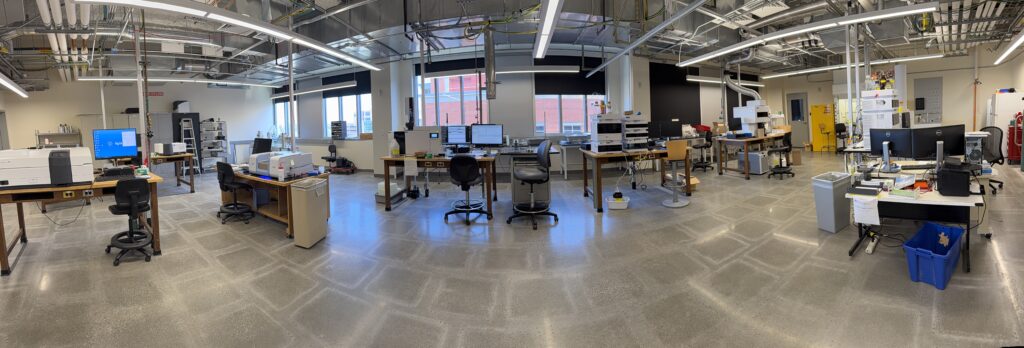
ALCA provides access to a suite of advanced analytical instruments located in the University of Vermont Chemistry Department, room Discovery Hall W414. Detailed information on each instrument, including capabilities, applications, and access requirements, is provided below.
Chromatography Instruments
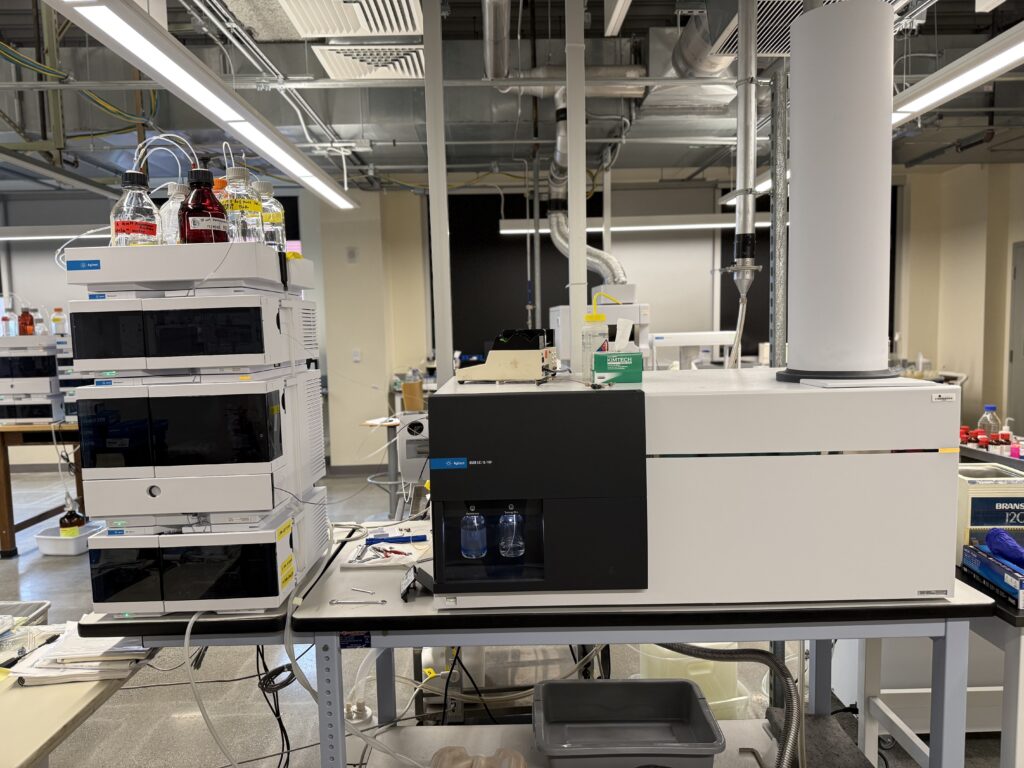
Liquid Chromatography – Quadrupole Time of Flight (LC-QTOF)
Learn more about the LC-QTOF
The LC-QTOF provides high-resolution, accurate mass analysis for the identification and quantification of small molecules in complex samples. Coupled with chromatograph separation using analytical columns, the instrument enables confident compound characterization through exact mass measurements, isotopic pattern analysis, and MS/MS fragmentation. The LC-QTOF is well-suited for applications requiring high sensitivity, selectivity, and structural information across diverse research areas.
Potential Applications
Chemical Analysis
- Unknown compound identification using accurate mass
- Reaction monitoring and product characterization
Biological Applications
- Detection of peptide and MS/MS sequencing of peptides for identification and characterization
- Analysis of intact proteins (low-mid kDa range) and proteolytic digests
- Metabolomics
- Lipidomics
Environmental Analysis
- Detection of pesticides, PFAS, and emerging contaminants
- Non-targeted screening of environmental samples
- Trace-level analysis in water and soil extracts
Pharmaceutical Analysis
- Drug and metabolite identification
- Stability studies
- Quanitative analysis
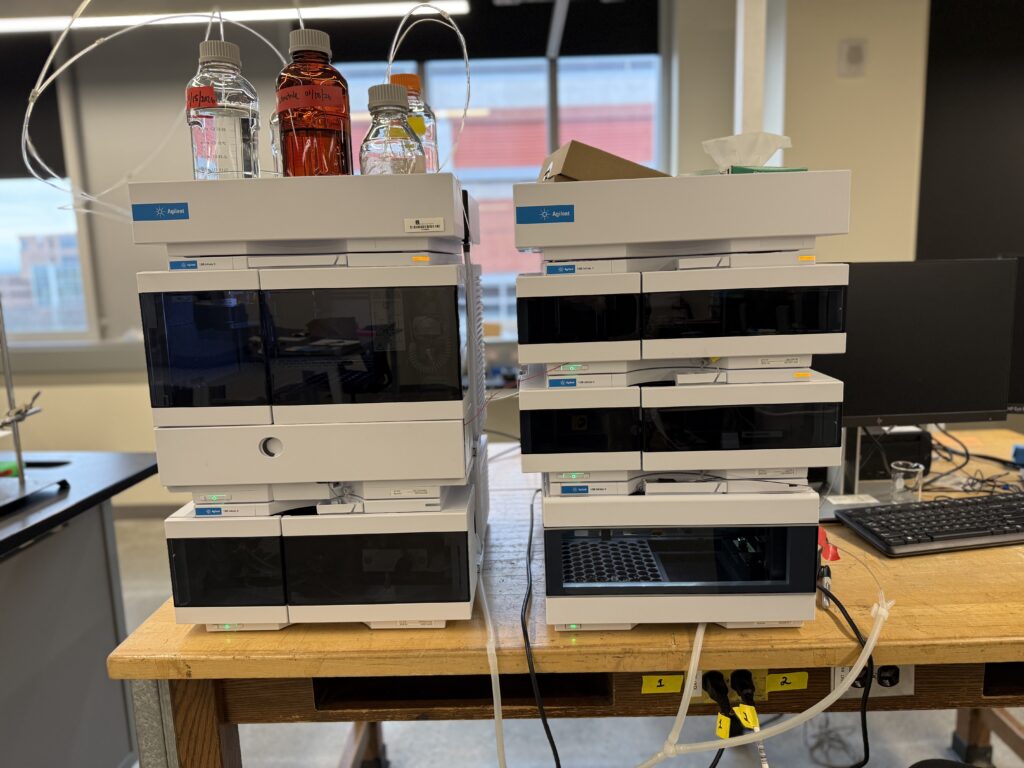
Liquid Chromatography – Refractive Index Detector – Diode Array Detector – Fluorescence Detector (LC-RID-DAD-FLD)
Learn more about the LC-RID-DAD-FLD
This liquid chromatography system combines fluorescence, diode array, and refractive index detection to support flexible, multi‑mode analysis of chemically diverse compounds. Configured for analytical and preparative‑scale columns, the instrument enables both high‑quality quantitative analysis and compound purification. The complementary detectors allow sensitive quantitation, spectral confirmation, and detection of analytes with limited UV activity, making the system well-suited for complex sample matrices.
Potential Applications
Chemical Analysis
- Separation and quantification of organic compounds
- Reaction monitoring and product analysis
- Impurity profiling
Biological & Biochemical Analysis
- Peptide and protein seperation
- Fluorescent biomolecule detection
- Analysis of naturally fluorescent or derivatized compounds
- Carbohydrate analysis
- Sample cleanup prior to LC-MS
- Fraction collection for targeted downstream analysis using QTOF
Environmental Analysis
- Organic contaminant analysis: Pesticides, herbicides, etc
- Dissolved organic matter
- Analysis of UV-active and fluorescent organic species
- Separation of plant extracts and complex organic mixtures
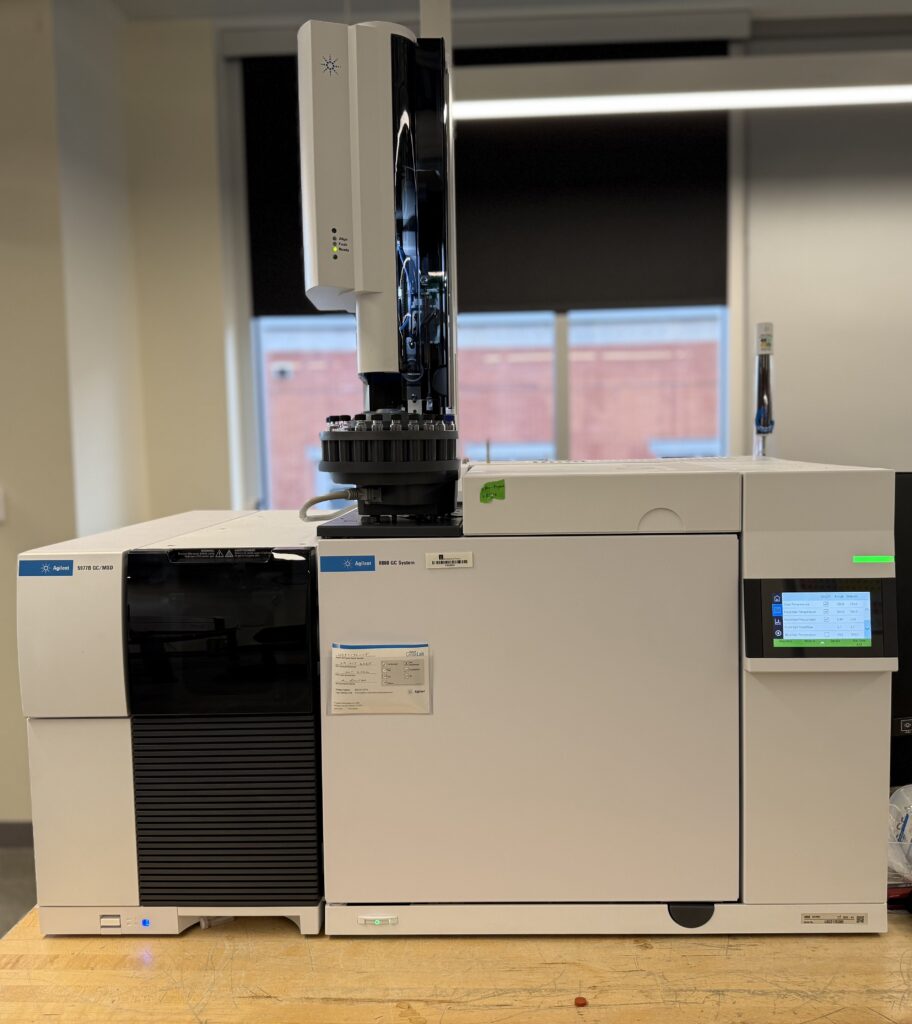
Gas Chromatography – Mass Spectrometry (GC-MS)
The GC‑MS supports the separation and identification of volatile and semi‑volatile compounds. Combining chromatographic resolution with mass spectral detection, the instrument enables qualitative identification, library matching, and quantitative analysis of complex mixtures, commonly used for environmental, forensic, and chemical characterization applications.
Potential Applications
Chemical Analysis
- Unknown compound identification via fragmentation patterns
- Reaction monitoring and product characterization
Materials & Industrial Analysis
- Polymer additives and degradation products
- Hydrocarbon characterization
Environmental Analysis
- VOCs
- SVOCs
- Pesticides and Pollutants
Food, Flavor & Fragrance
- Aroma compound profiling
- Essential oil analysis
- FAMES
- Flavor compound identification
- Terpenes
Spectroscopy Instruments
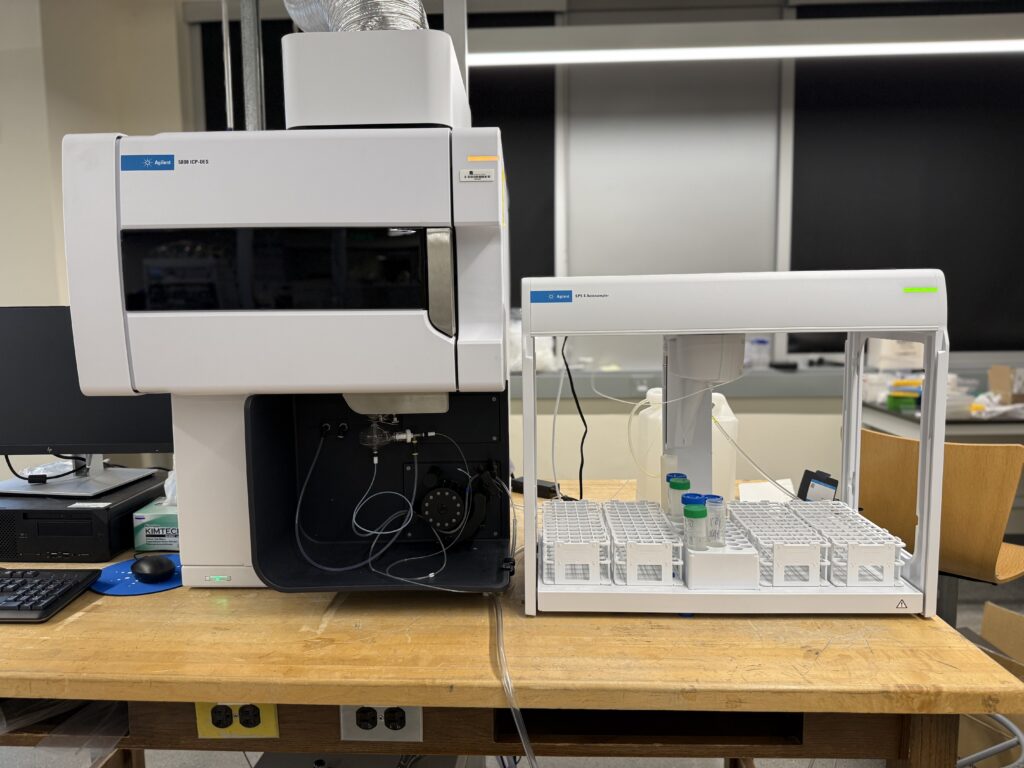
Inductively Coupled Plasma – Optical Emission Spectroscopy (ICP-OES)
The ICP‑OES provides multi‑element elemental analysis with a wide dynamic range and high throughput. The instrument supports quantitative determination of metals in liquid samples and digested solids, making it well suited for environmental, agricultural, and materials‑focused research.
Potential Applications
Chemical & Material Analysis
- Metal composition: alloys, coatings
- Catalyst analysis: metal loading (e.g. Pt, Pd, Au)
- Leaching studies: tracing metal loss into solution
Environmental Analysis
- Trace metals in water and soil
- Heavy metal contamination studies
- Nutrient analysis
Biological & Agricultural Analysis
- Plant tissue analysis: nutrient uptake (Fe, Mn, Zn, Cu)
- Food analysis: mineral content and contamination
- Biological samples: metals in digested tissues
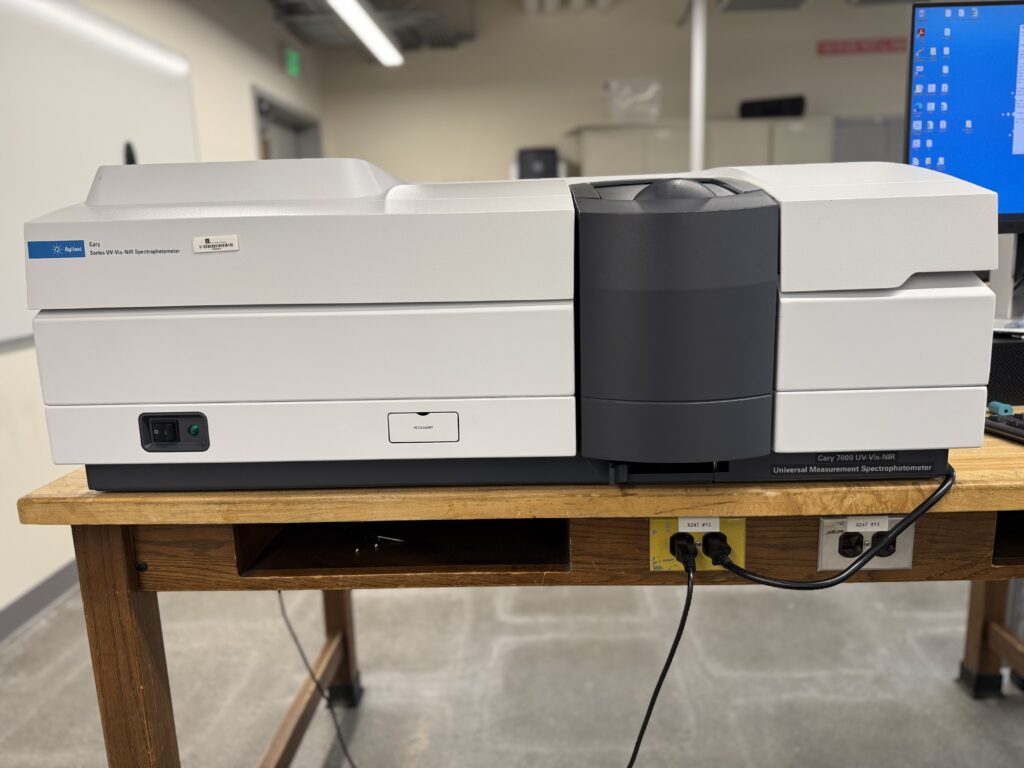
Ultraviolet – Visible – Near Infrared Spectroscopy (UV-VIS-NIR)
Learn more about the UV-VIS-NIR spectrophotometer
The UV-VIS-NIR spectrophotometer supports absorbance measurements across the ultraviolet, visible, and near‑infrared regions of the electromagnetic spectrum. The instrument is used for quantitative and qualitative analysis, reaction monitoring, and characterization of molecular and material properties in solution or in the solid state.
Potential Applications
Chemical Analysis
- Quantitation absorbance measurements
- Reaction kinetics
- Chromophore characterization
Material & Thin Film Characterization
- Optical coatings
- Thin films:
- Thickness and wavelength-dependent optical behavior
- Photonic materials
- Transparent conductive materials
- Semiconductor analysis
Biological & Biochemical Analysis
- Protein quantification:
- UV absorbance at 280 nm
- DNA/RNA analysis:
- Nucleic acid absorbance measurements
- Biomolecule characterization:
- Optical behavior of biological systems
Environmental Analysis
- Colorimetric assays
- Photocatalyst characterization
- Water and organic analysis
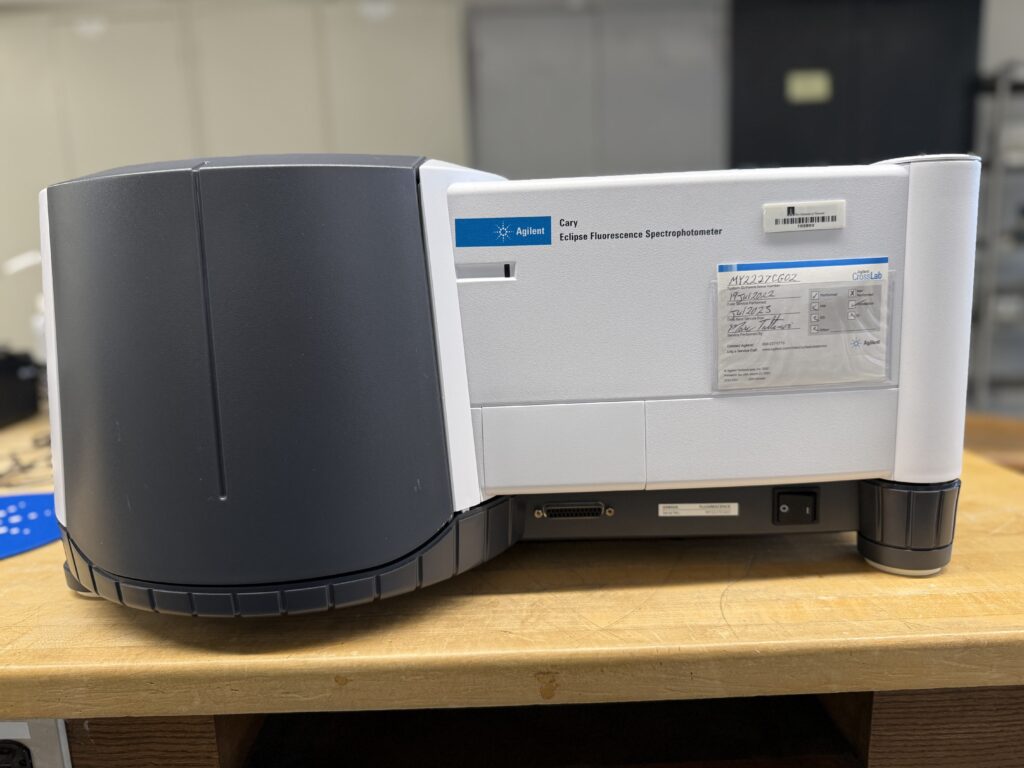
Fluorescence Spectroscopy
Learn more about the fluorimeter
The fluorimeter provides sensitive fluorescence‑based detection for qualitative and quantitative analysis of fluorescent compounds. The instrument is well suited for low‑concentration measurements, studies of molecular interactions, and applications requiring high sensitivity and selectivity, including biological, environmental, and chemical research.
Potential Applications
Chemical Analysis
- Characterization of fluorescents compounds
- Quenching Studies
- Reaction monitoring
Biological & Molecular Interactions
- Protein fluorescence
- monitor conformational changes through intrinsic tryptophan and tyrosine fluorescence
- Ligand binding studies
- Bioluminescent assays
Environmental Analysis
- Dissolved organic matter (DOM):
- EEM characterization
- Polycyclic aromatic hydrocarbons (PAHs)
- Photodegradation studies
- Trace-level fluorescence detection
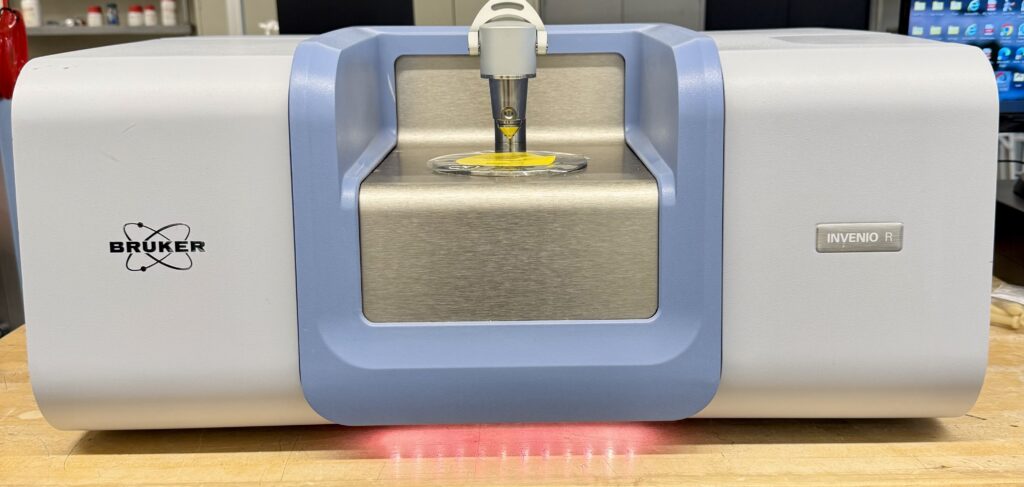
Fourier Transform Infrared Spectroscopy (FTIR)
The FTIR spectrometer enables molecular structure and functional group analysis through infrared absorption measurements. The instrument supports qualitative identification, material characterization, and comparison of unknown samples, and is applicable to solids, liquids, and thin films across a range of research and instructional uses.
Potential Applications
Chemical Analysis
- Functional group identification: Characterization of O–H, C=O, C–H, N–H, and other vibrational modes
- Reaction monitoring: Tracking chemical transformations through spectral changes
- Compound verification: Comparison against reference spectra for material identification
- Hydrogen bonding studies: Monitoring shifts in vibrational frequencies
Material & Thin Film Characterization
- Polymer characterization: Identification of polymer composition and additives
- Thin film analysis: Functional group characterization of deposited films and coatings
Biological & Biochemical Analysis
- Biomolecule characterization: Functional group analysis of proteins and biological materials
- Pharmaceutical identification: Verification of active ingredients and excipients
- Formulation analysis: Characterization of complex pharmaceutical mixtures
- Solid-state studies: Analysis of crystalline and amorphous material behavior
Environmental Analysis
- Microplastics characterization: Polymer identification through infrared spectral matching
- Organic residue analysis: Detection of oils, greases, and environmental residues
- Environmental solids analysis: Identification of unknown materials and contaminants
Pricing
Pricing for analytical services and instrument access is available for UVM users and external customers, including academic, industry, and government partners. Rates are structured based on user category and level of service, with separate pricing for independent use by trained users and staff‑assisted analysis, training, or consultation. Fees are designed to support instrument maintenance, facility operations, and technical staff support. In addition to ALCA instrumentation, this pricing document also includes rates for the NMR Facility within the UVM Department of Chemistry. All rates are subject to University of Vermont policies and may be updated as needed.