
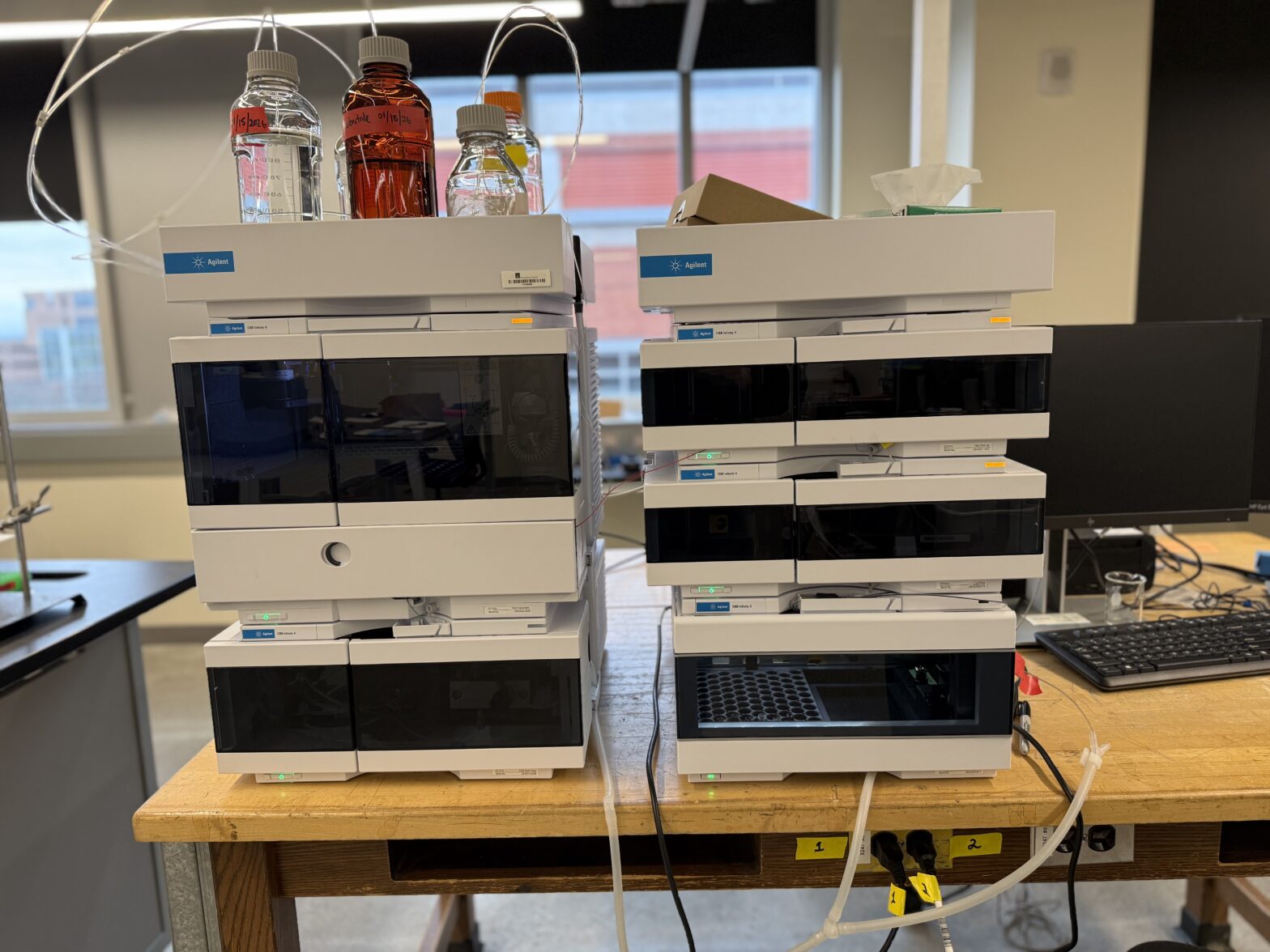
The Agilent 1260 Infinity HPLC System provides robust and flexible separation of compounds in solution using a range of detection methods. The system supports multiple detectors, enabling both qualitative and quantitative analysis across diverse sample types.
Available detectors include refractive index (RID), diode array detection (DAD), and fluorescence detection (FLD), allowing analysis of compounds with varying optical and chemical properties.
Detection Methods
Refractive Index Detector (RID)
- Universal detector for compounds lacking UV absorbance
- Ideal for:
- Sugars
- Polymers (gel permeation chromatography (GPC) and size exclusion chromatography (SEC))
- Alcohols
Diode Array Detector (DAD)
- UV-Vis
- Simultaneously collects data at multiple wavelengths
- Provides spectral information
- Ideal for:
- Compound identification
- Quantification
- Purity assessment
Fluorescence Detector (FLD)
- Highly sensitive for fluorescent compounds
- Lower detection limits than UV
- Ideal for:
- Biomolecules
- Trace-level detection
Fraction Collection Capability
Agilent 1260 Infinity II Analytical-Scale Fraction Collector
The system is equipped with an analytical-scale fraction collector, enabling isolation and collection of separated compounds following chromatographic separation.
What This Enables
- Isolation of purified compounds from complex mixtures
- Collection of individual peaks based on retention time or detector signal
- Preparation of samples for:
- LC-MS (QTOF)
- NMR analysis
- Further chemical characterization
Compatible Column Dimensions
The system is compatible with a range of analytical preparative HPLC columns, including:
Analytical Columns
Typical dimensions:
- 2.1 mm ID
- 3.0 mm ID
- 4.6 mm ID
Sample Requirements
Solvent & Buffer Compatibility
- Samples should be fully dissolved in LC-compatible solvents
- Aqueous/organic mixtures (e.g. water, methanol, acetonitrile)
- Preferred LC-MS or HPLC grade solvents
Sample Cleanliness
- Filter samples using 0.2 µm or 0.45 µm filters or alternatively centrifuge to remover particles
- Particles can
- Clog the LC system
- Damage the column
- Affect reproducibility
Concentration Guidelines
- Typical working range:
- µM to mM for most analyses
Rates
| Service (per hour) | UVM Users | External Users |
|---|---|---|
| User Instrument Time | $19.94 | $29.91 |
| Staff Assisted Use | $91.87 | $137.80 |
| Training Session | $91.87 | $137.81 |
| Prices as of July 1, 2025 |
Training
Interested in running the HPLC independently?
Schedule training to learn method development, detector selection, and data analysis.
Analysis
Need help with separations or quantitation?
Submit samples for full-service HPLC analysis, including method development and data interpretation.